



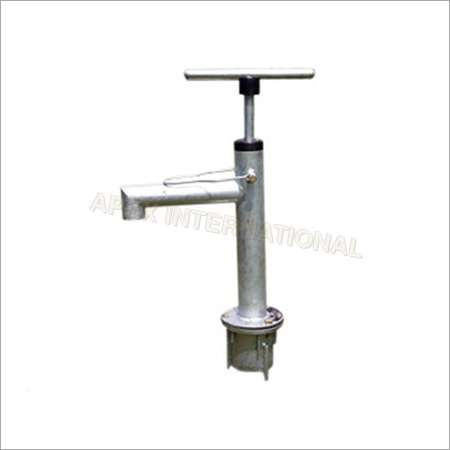
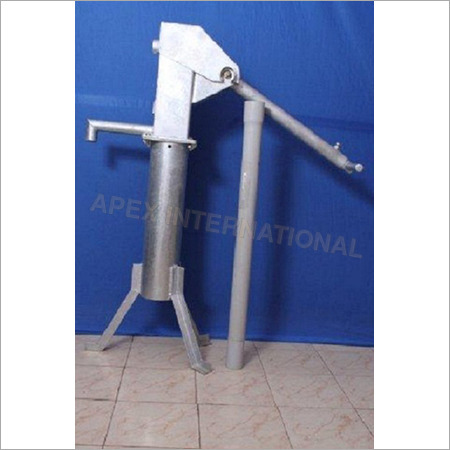
Direct Action Hand Pumps
Product Details:
- Weight 19-35 kg (varies by size and model)
- Material Stainless Steel
- Pressure Operates at low to medium manual hand pressure
- Diameter 50 mm, 63 mm, 75 mm, 100 mm (custom depending on model)
- Structure Column assembly with piston and foot valve
- Shape Cylindrical with Flanged Base
- Usage Manual water extraction from wells and boreholes
- Click to View more
X
Direct Action Hand Pumps Product Specifications
- Stainless Steel
- Manual water extraction from wells and boreholes
- 19-35 kg (varies by size and model)
- Operates at low to medium manual hand pressure
- 50 mm, 63 mm, 75 mm, 100 mm (custom depending on model)
- Column assembly with piston and foot valve
- Cylindrical with Flanged Base
- Single lever, horizontal hand-operated
- +/- 0.5 mm (machined parts)
- Rural and agricultural water supply, irrigation, drinking water
- Sliver
- Direct Action Hand Pump
- Corrosion-resistant coated or painted
- Up to 30 meters (varies by design)
- 0C to 50C
- Low, easy to install and repair in field conditions
- Rubber / Synthetic Cup Leather
- PVC / Galvanized Iron
- 15 to 30 liters per minute (depending on bore depth and model)
- IS 15500 / BIS certified
- Galvanized Iron / Stainless Steel
- 7 meters (direct action designs)
Product Description
The provided Direct Action Hand Pumps are physically worked. They utilize human power and mechanical benefit to move liquids or air from places to places. These are generally utilized in every nation for an assortment of modern, marine, water system and recreation purposes. There are various kinds of pumps accessible, generally working on a cylinder, or turning vane standard with a check valve on the section and leave ports to the chamber working in restricting ways. Our Direct-Action Hand Pumps are either cylinder or plunger as well as are certain displacement. These are ordinarily utilized in developing nations for both network supply and self-supply of water. They can be introduced on boreholes or hand-burrowed wells.
Direct Action Hand Pumps Features:
- Effective lift and suction properties
- Used for varied pumping requirements
- Can be provided with rotary vane, or diaphragm
- Replacement and repair are an easy task
|
Water level |
10 mtr - 15 mtr |
|
Brand |
Apex |
|
Max Flow Rate |
21 liter in 30 stroke |
|
Material |
Stainless Steel |
|
Operating Depth |
7-14 m |
|
Stroke Length |
21 liter in 30 stroke |
We are manufacturer & Exporter of Direct Action Hand Pumps mainly in Angola Burkina Faso Burundi Cameroon Chad Congo Congo Ethiopia Ghana Guinea Kenya Liberia Madagascar Malawi Mal Mozambique Niger Nigeria Rwanda Senegal Sierra Leone Somalia South Africa South Sudan Sudan Tanzania Togo Uganda Zambia Sri lanka New Guinea Conakry Cameron etc
We export to Nigeria, Uganda, Netherlands and Burkina Faso.
Versatile Water Extraction Solution
Our Direct Action Hand Pumps are engineered to serve both manual water extraction from wells and fuel injection applications. Each pump is optimized for low to medium hand pressure, ensuring ease of use across varying age groups and physical capabilities. With multiple diameter options, these pumps cater to a range of borehole sizes and site conditions.
Durable Construction and Reliable Performance
Constructed with high-quality stainless steel, galvanized iron, and corrosion-resistant finishes, these pumps withstand challenging environments and variable water conditions. The use of rubber or synthetic cup leather seals ensures long-term leak-proof operation. Easy in-field assembly and repair make them especially useful for rural and remote installations.
Designed for Safety and Efficiency
The single-lever, horizontal hand-operated handle allows controlled, ergonomic operation. Designed in accordance with IS 15500/BIS standards, the pumps maintain a high level of quality and compliance. Their lightweight construction (19-35 kg) and modular structure further simplify installation, transportation, and storage.
FAQ's of Direct Action Hand Pumps:
Q: How do Direct Action Hand Pumps operate for water extraction?
A: Direct Action Hand Pumps use a horizontal, single-lever hand mechanism to manually draw water from wells or boreholes. The operator lifts and lowers the handle to move a piston within a cylindrical assembly, pulling water up through a rising main pipe.Q: What are the ideal applications for these hand pumps?
A: These pumps are best suited for rural water supply, agricultural irrigation, and manual drinking water extraction from wells or boreholes. They can also be adapted for distributor, supplier, and fuel injection pump uses based on their robust design.Q: Where can these pumps be installed and how deep can they go?
A: The pumps are designed for installation in rural or agricultural locations, and can be set up in wells or boreholes with depths up to 30 meters, depending on the model and site conditions.Q: What materials are used in manufacturing these pumps, and how do they benefit the user?
A: Key components are made from galvanized iron, stainless steel, and PVC, ensuring corrosion resistance, durability, and long-term service even in harsh environments. This reduces maintenance needs and replacement frequency.Q: How easy is it to maintain or repair the hand pumps?
A: Maintenance is straightforward due to their simple design and quality materials. Most parts can be easily accessed, repaired, or replaced on-site with basic tools, minimizing downtime in field environments.Q: When should the pump's seals or components be checked or replaced?
A: Periodic inspection is advised to ensure the rubber or synthetic cup leather seals remain intact and leak-free. The frequency of checks depends on usage but generally should be done every six months to a year.Q: What certification standards do these pumps comply with?
A: The pumps meet IS 15500/BIS certification requirements, ensuring they adhere to Indian standards for performance, quality, and reliability.Tell us about your requirement

Price:
Quantity
Select Unit
- 50
- 100
- 200
- 250
- 500
- 1000+
Additional detail
Mobile number
Email

Other Products in 'Hand Pumps' category

Contact Details
APEX INTERNATIONAL
GST : 09AANFA7726J1ZZ
GST : 09AANFA7726J1ZZ

- Corporate Office : B-277, Sector-50,Noida - 201301, Uttar Pradesh, India

- Phone : 07971459441

- Dr. Lalit Khanna (Chairman)
- Mobile : 07971459441
-
 Send Inquiry
 Send Inquiry
Unit I : 1:E-9, Site B, Surajpur Indl. Area Greater Noida (U.P)
Unit II : 11:F-4, Site B, Surajpur Indl.Area Greater Noida (U.P)
(Nearest Airport is IGI Airport, New Delhi. And Nearest Metro Station is Noida City Centre)
Unit II : 11:F-4, Site B, Surajpur Indl.Area Greater Noida (U.P)
(Nearest Airport is IGI Airport, New Delhi. And Nearest Metro Station is Noida City Centre)
 Send Inquiry
 Send SMS
 Call Me Free
|


 |
APEX INTERNATIONAL
All Rights Reserved.(Terms of Use) Developed and Managed by Infocom Network Private Limited. |
